
Chicago Boat Show 2027: Plan Your Boat Canvas, Enclosure and Upholstery Upgrades This Winter

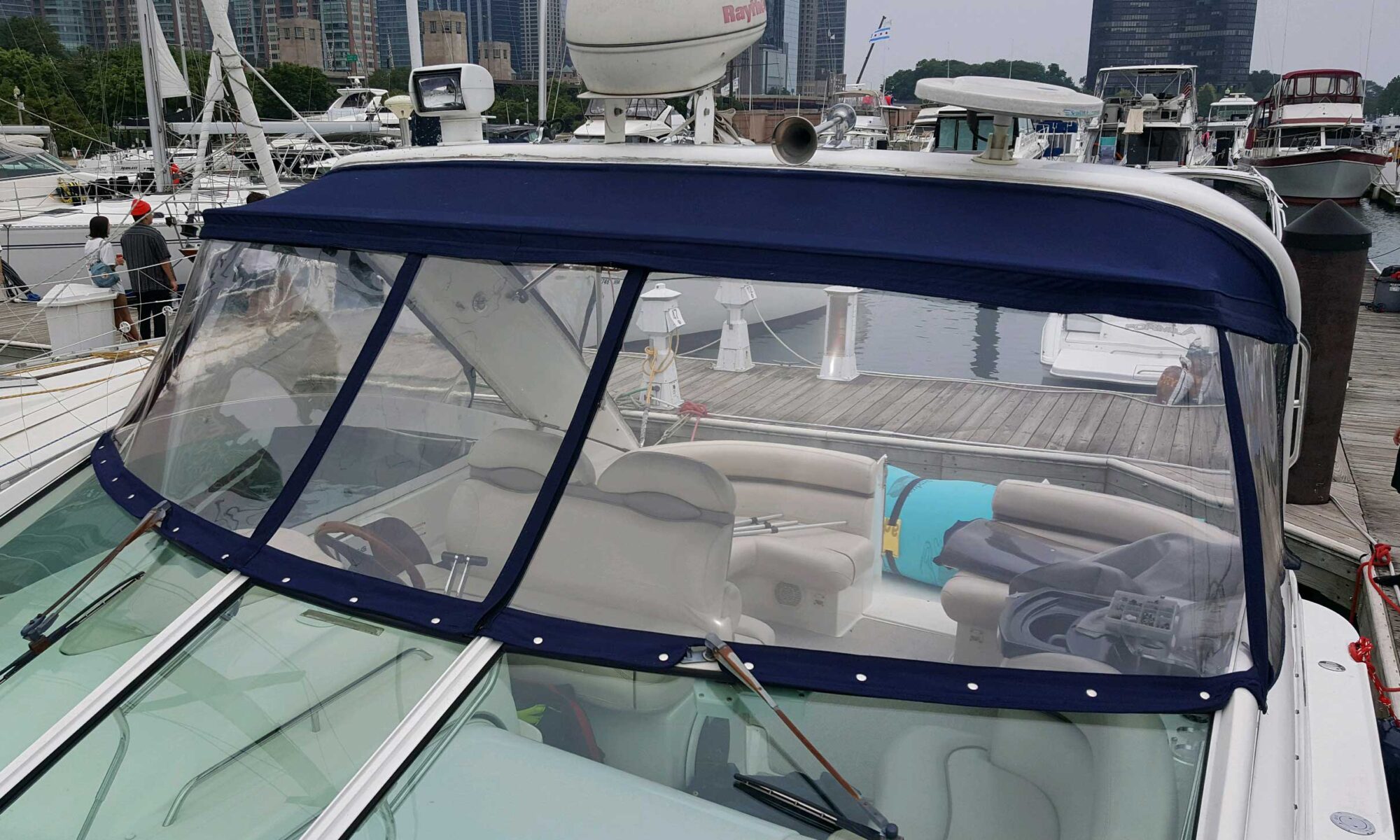
Replaced new isinglass windows by Chicago Marine Canvas

The boats are out of the water, the harbors are quiet, and Lake Michigan won’t feel like boating weather for months. But for a lot of Chicago boat owners, this is when next season starts. The Discover Boating Chicago Boat Show returns February 3-7, 2027. It’s the best chance all winter to walk through a wide selection of new boats, see what builders are doing with canvas, glass and upholstery, and come home with a clear plan for your own boat.

At Chicago Marine Canvas, we build custom canvas, enclosures, upholstery and flooring for boats from the Wisconsin border down to St. Joseph and Benton Harbor, Michigan. Here’s how to use the Chicago Boat Show 2027 and the rest of the off-season to plan your boat canvas and interior upgrades. That way the work is done before spring commissioning instead of stuck in the spring rush.

Navy blue boat canvas top with new clear vinyl windows over a boat's windshield at a marina, made by Chicago Marine Canvas

Chicago Boat Show 2027: Dates, Location and Tickets

The show is back at the Donald E. Stephens Convention Center in Rosemont for its third year. Here are the basics, from the official show info page:

  • Dates: Wednesday, February 3 through Sunday, February 7, 2027
  • Location: Donald E. Stephens Convention & Conference Center, 5555 N. River Road, Rosemont, IL 60018
  • Hours: Wednesday 2 PM-8 PM, Thursday and Friday 11 AM-8 PM, Saturday 10 AM-8 PM, Sunday 10 AM-5 PM
  • Tickets: Sold online only through the official show website, with no sales at the door. Tickets are good for one day and can be shown on your phone. The show offers discounted pre-show tickets.
  • Getting there: Parking in the convention center garage is $20. The convention center is about a two-block walk from the CTA Blue Line’s Rosemont station, and the free Rosemont Entertainment Circulator (Pace Bus 811) also stops there. See Getting to the Show for details.

Give yourself a few hours. If your main goal is studying canvas and upholstery, you’ll want time to climb aboard, look closely and ask questions.

Why the Boat Show Is a Great Canvas Research Trip

Even if you’re not shopping for a new boat, the show is a useful place to look at marine fabric work. Builders bring their newest models with factory canvas, hardtops, enclosures and upholstery. You can see dozens of setups side by side in an afternoon. That makes it much easier to decide what you want on your own boat.

Many of the upholstery fabrics you’ll see on new yachts are the same materials we work with. For example, Silvertex, a coated marine upholstery fabric, has become popular with the move toward more contemporary yacht interiors. You’ll find it on many new yacht models. Seeing and touching it in person is more useful than looking at a photo.

What to Look At (and Photograph) at the Show

Bring your phone and take lots of pictures. When you sit down with a fabricator later, photos of details you liked are worth more than any description. Here’s what to pay attention to.

Enclosures and windows

  • Forward windows: Look at how builders handle the windshield area. Many larger boats use semi-rigid forward windows (we’ve built many enclosures with Makrolon forward windows) with flexible clear panels on the sides and aft.
  • Clarity and coatings: Look through the side curtains. Strataglass, the press-polished clear vinyl brand that’s been around since 1994, is coated with VueShield to resist scratching and UV damage. The company advertises 99.5% optical clarity. That difference is easy to see in person.
  • Zippers and roll-ups: Notice which panels unzip or roll up for ventilation, how they’re secured, and whether you can open them easily from inside.
  • Aft coverage: Some boats extend the aft frame to cover more of the cockpit seating. If your factory aft canvas only shades a small part of your cockpit, that’s worth noting.

Canvas color and fabric

Look at canvas colors against hull colors and upholstery. Navy, black, gray and tan all read differently depending on the gelcoat. Seeing them on full-size boats helps you pick something you’ll still like in five years.

Upholstery details

  • Quilting and stitching patterns, like diamond quilting or double-needle seams
  • Two-tone color layouts and piping
  • Bolster, backrest and sunpad shapes, including storage, cupholders and recliner features
  • How seating holds up to sitting, leaning and climbing over
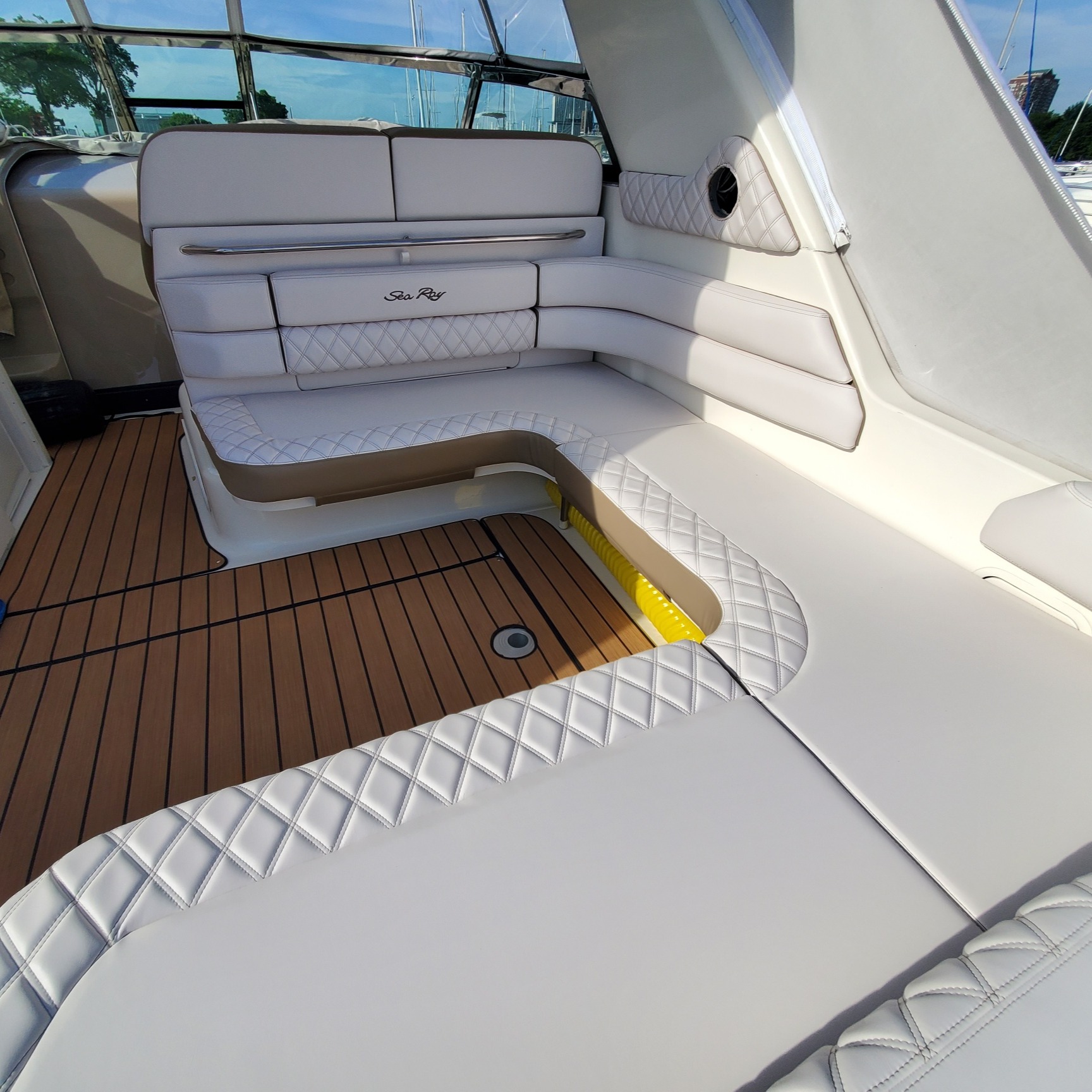
White Sea Ray exterior cockpit seating with diamond quilting above teak-look decking, upholstered by Chicago Marine Canvas

Flooring

Check what builders are putting underfoot: foam decking on swim platforms, woven vinyl in cockpits, synthetic teak on decks. If you’re weighing options for your own boat, our boat flooring comparison explains how they differ.

Questions to Ask at the Show

If you’re shopping for a new boat, ask the dealer:

  • What canvas comes standard, and what is optional?
  • Is a full enclosure available, and what window material does it use?
  • Does the boat come with a storage or mooring cover?
  • What fabric is used on the exterior upholstery?

If the answer is “not included,” that doesn’t have to change your decision. Custom canvas made for the boat after delivery is often a better fit for the way you use it than a factory option.

Why Winter Is the Time to Book Custom Canvas

Spring commissioning on southern Lake Michigan is short. When boats start going back in, everyone wants new covers, enclosures, window replacements and upholstery at the same time. Starting your project in winter has a few advantages:

  • The boat isn’t in use. Measuring and fitting don’t cost you any boating days.
  • Time to decide. You can compare fabric samples, colors and window options without rushing.
  • Your boat goes in ready. New canvas or upholstery is on the boat for launch day instead of waiting in a backlog.

Our process is built for this. We measure with a digitized, laser-based canvas measuring system that creates a 3D template of your boat. That means we don’t need your boat or your old canvas in our shop to build something new. Fabric is cut on an automated cutting table, sewn in our shop, and then our team installs it on the boat. You can read more about how a custom canvas project works.

We also work at marinas and storage yards across our service area through the off-season. Your boat doesn’t have to come to us.
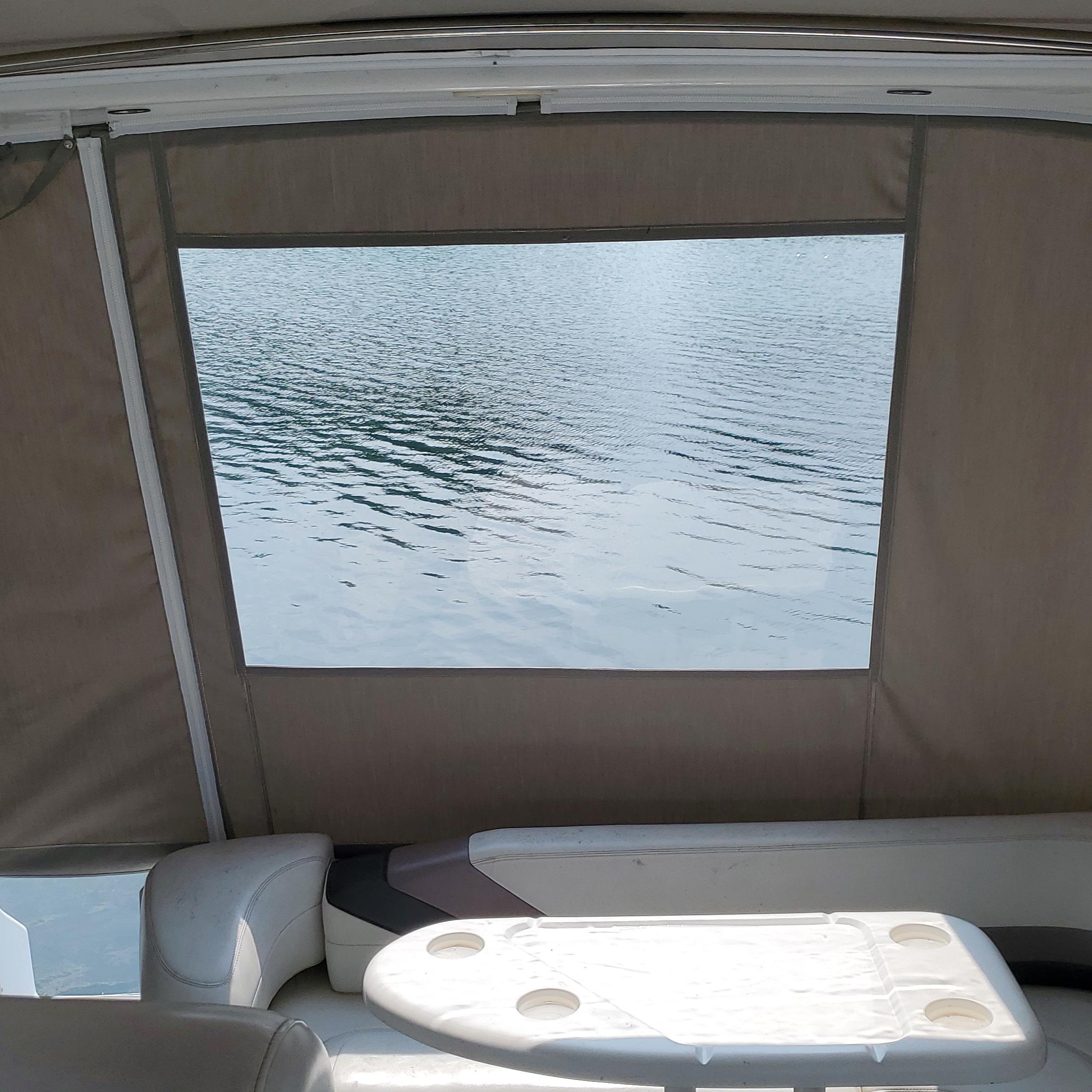
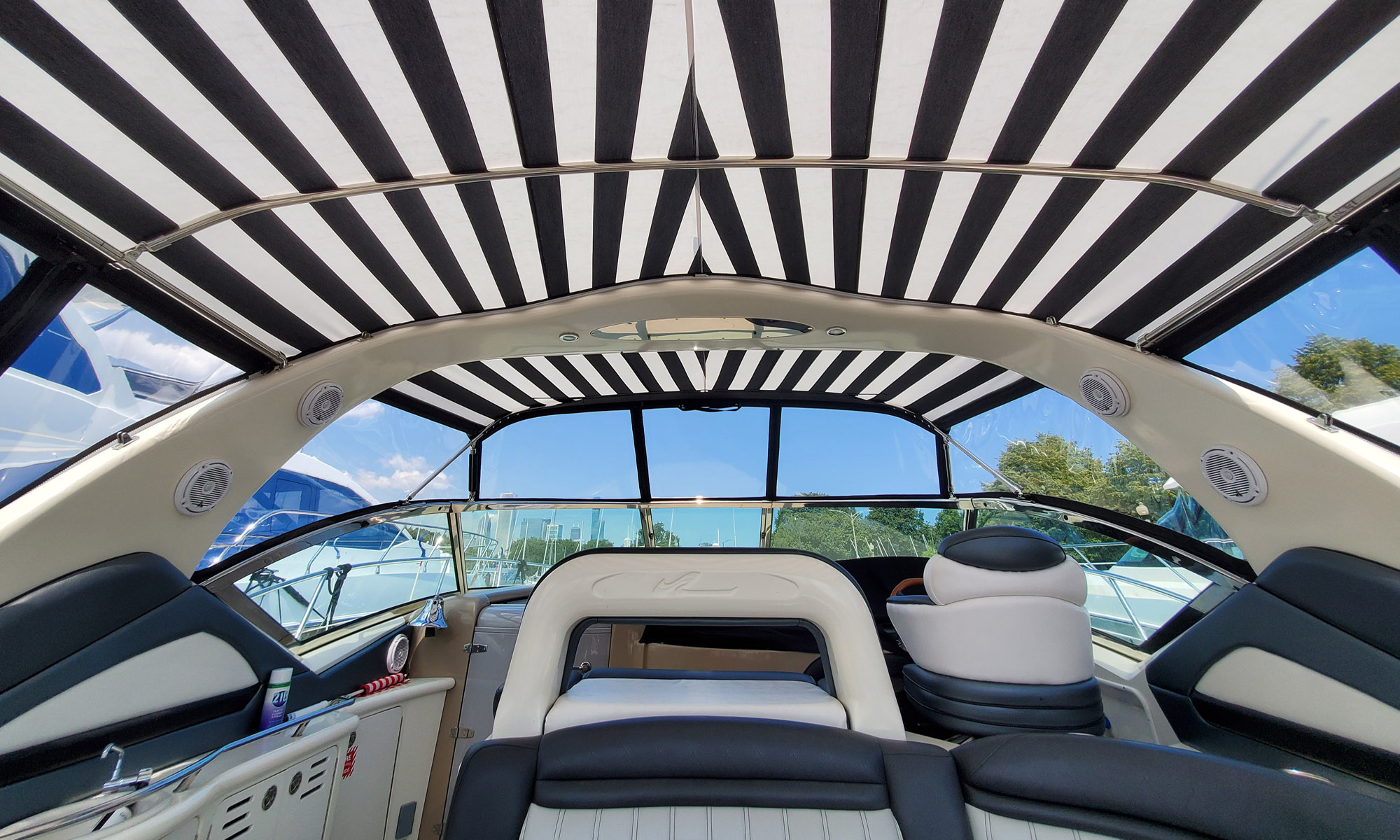
Inside a boat's tan canvas aft enclosure with a large clear window looking out over the water, built by Chicago Marine Canvas

A Simple Winter Plan

  1. Now through January: Look over your current canvas, windows and upholstery. Note torn seams, failing zippers, cloudy or scratched windows, and cracked or faded seats. Take photos.
  2. February 3-7: Go to the Chicago Boat Show. Photograph enclosures, windows, fabrics and seating you like.
  3. Right after the show: Send us your photos and ideas. We’ll talk through options, from a new canvas enclosure or Strataglass window replacement to boat upholstery and flooring.
  4. Late winter: We measure the boat where it’s stored, build the project, and schedule installation.
  5. Spring: Your boat goes back in the water ready for the season.

Start Planning Your Spring Upgrade

Whether your boat is stored in Chicago, on the North Shore, in Northwest Indiana or in Southwest Michigan, we’d be glad to help you turn your boat show ideas into canvas and upholstery that fit your boat. Contact Chicago Marine Canvas with a few photos, or call (312) 487-1133. Our shop is at 2815 W Montrose Ave in Chicago.
Boat Flooring Options: Foam Decking vs. Woven Vinyl vs. Synthetic Teak

Foam decking by Chicago Marine Canvas

If your boat is shrink-wrapped in a storage yard right now, the floor is probably the last thing on your mind. Winter is the best time to fix it, though. A worn, stained or peeling cockpit carpet is one of the first things people notice when they step aboard. Replacing it takes careful measuring and fabrication time, and that work fits right into the months you aren’t using the boat anyway.

At Chicago Marine Canvas, we install three main types of boat flooring for owners from the Wisconsin border to St. Joseph, Michigan: closed-cell foam decking (HydraFoam and GatorStep), Infinity Luxury Woven Vinyl, and PlasDECK synthetic teak. Each one is good at something different. Here’s how they compare, and how to pick the right one, or the right mix, for the way you use your boat.

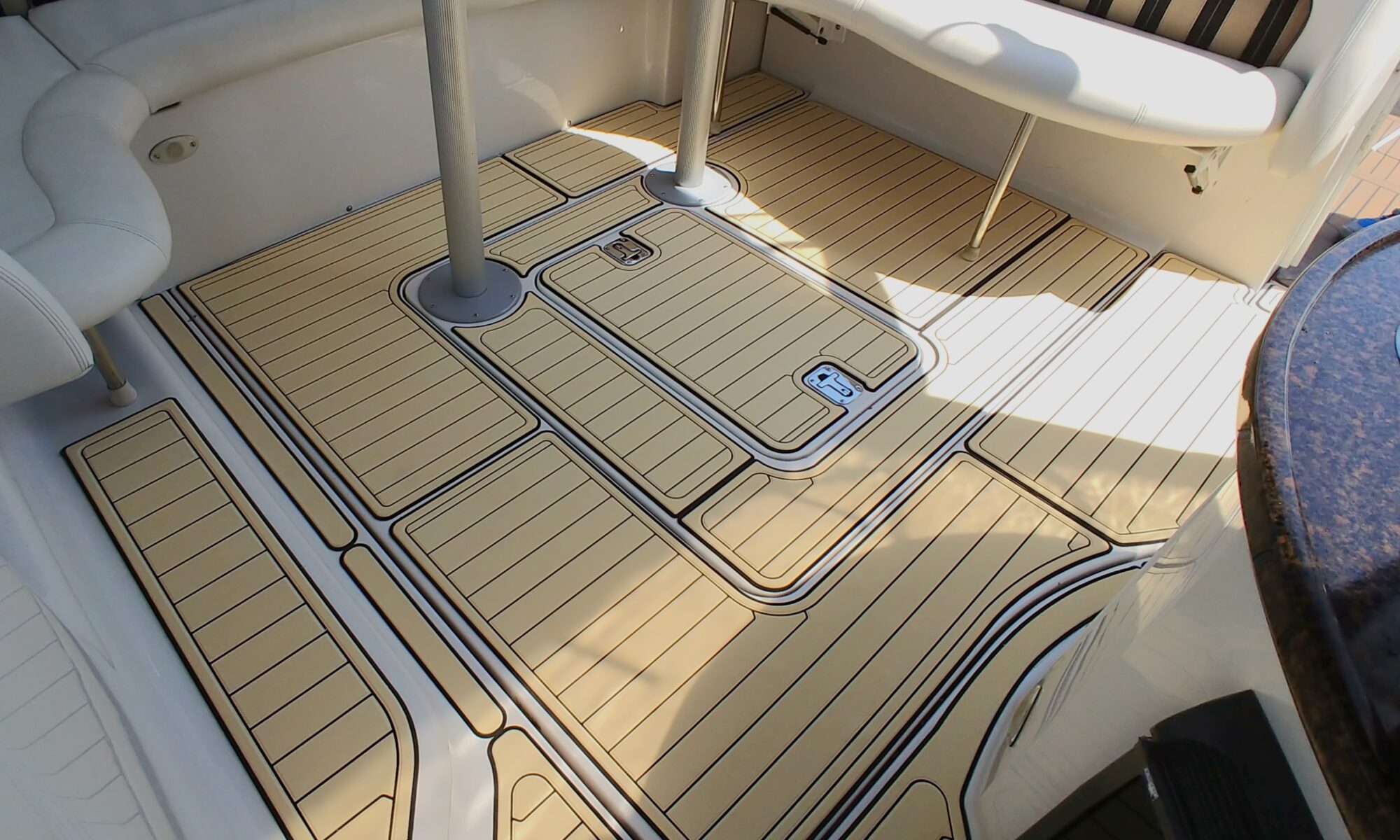
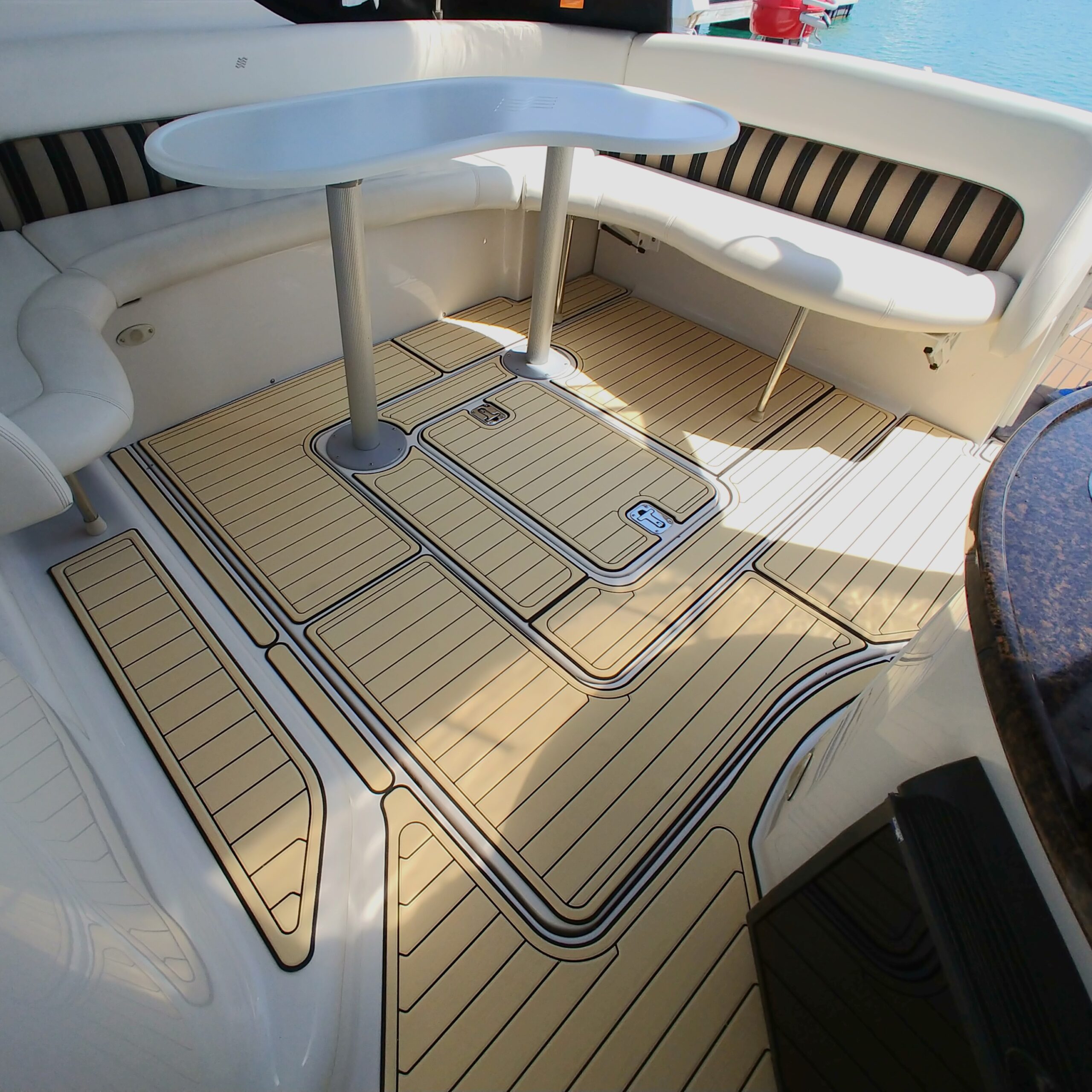
Teak-look foam decking with black seam lines covering a cruiser's cockpit floor around the table pedestals, installed by Chicago Marine Canvas

Why Winter Is the Right Time for New Boat Flooring

Spring commissioning season on Lake Michigan is short and busy. When the boats go back in, everyone wants their canvas, upholstery and flooring done at the same time. Plan your flooring now and you get:

  • No lost boating days. The boat’s out of service anyway, so measuring and installation don’t cut into your summer.
  • Time to decide. You can look at samples, compare colors against your upholstery, and add details like a logo or boat name without rushing.
  • A finished floor on launch day. Your boat goes back in looking new instead of waiting in the spring backlog.

We work at marinas and storage facilities across our service area all off-season. Not sure we can get to your boat? Check our guide to the marinas we service all winter.

Option 1: Closed-Cell Foam Decking (HydraFoam and GatorStep)

Foam decking has become the go-to upgrade for swim platforms, steps, cockpit soles and helm stations. It’s a soft, cushioned sheet material, cut to the exact shape of your deck and bonded in place. It’s closed-cell foam, so it doesn’t soak up water. Spilled drinks, sunscreen and fish mess sit on top, where you can rinse them off.

HydraFoam

HydraFoam, a Michigan-based manufacturer, makes its decking from a high-density, 100% closed-cell blend. It’s nearly all polyethylene (PE), with a small amount of ethylene-vinyl acetate (EVA) and added UV inhibitors. The company says that gives it very low water absorption and strong stain resistance. It’s non-slip wet or dry and comfortable underfoot, and you can add logos that are machined, laser-etched, or both.

GatorStep

GatorStep is a UV-resistant, PE-blended EVA closed-cell foam. It comes in sheets that can be laminated in layers of different colors and thicknesses, then CNC-routed to fit. GatorStep is also known for its laser textures, including realistic wood-grain looks, and for routed and laser-etched logos.

Where foam works best

  • Swim platforms and transom steps, where wet traction matters most
  • Cockpit soles on cruisers, bowriders and center consoles
  • Helm stations, where a cushioned surface is easier on your feet over a long day
  • Fishing boats, since closed-cell foam won’t hold onto fish blood or bait

See examples of our work on our foam decking page.

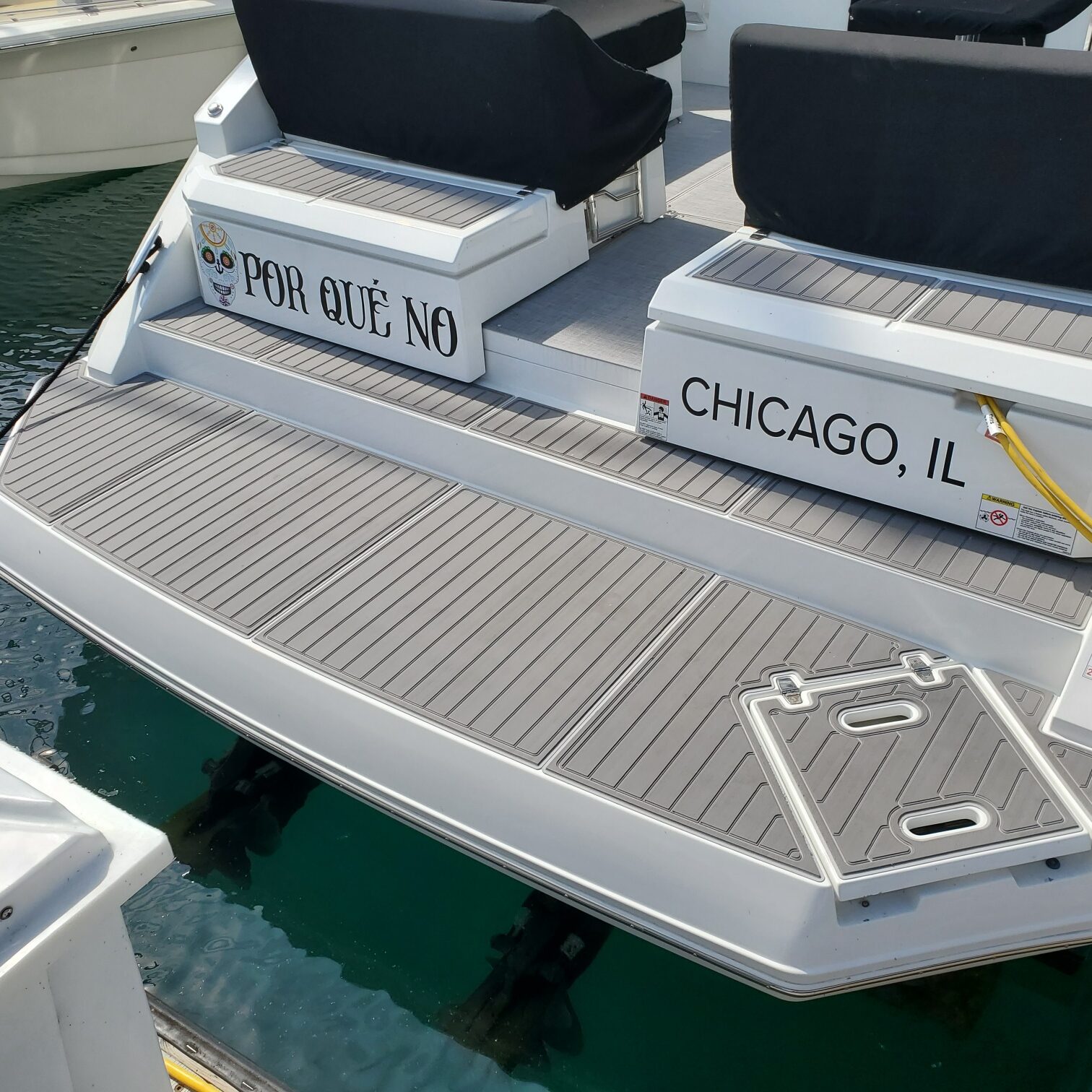
Gray teak-pattern foam decking on the swim platform and transom steps of a Chicago cruiser, installed by Chicago Marine Canvas

Option 2: Infinity Luxury Woven Vinyl

Like the look and feel of carpet but hate how traditional marine carpet holds water and smells musty? Woven vinyl fixes that. Infinity Luxury Woven Vinyl calls itself the first-to-market marine woven vinyl flooring, and it’s made in the USA. The woven vinyl face resists wear and fading, and it’s engineered with antimicrobial technology. It comes in 8’6″ and 10′ widths with several backing options, in patterns from simple linen weaves to teak-look designs.

You also get options for how it goes in. We can pattern Infinity to fit any boat’s interior or exterior and install it glued down, snapped in, or laid loose. Snap-in and loose-laid floors can be pulled up for cleaning or winter storage.

Where woven vinyl works best

  • Cockpits and aft decks where you want a softer, finished, “living room” look
  • Cabins, salons and companionway steps
  • Pontoons and deck boats with large open floor areas
  • Boats with pets or kids, since it cleans up easily

Learn more about the material and the patterns we carry on our marine carpet page.

Option 3: PlasDECK Synthetic Teak

Real teak looks great, but it needs regular cleaning and oiling, and eventually it needs replacing. PlasDECK is a synthetic teak decking made from a specially formulated flexible PVC. According to the manufacturer, it’s extruded in the Akron, Ohio area. It uses patented non-migrating plasticizers so it won’t dry out, crack or crumble over time. The UV protection is mixed through the whole material instead of sitting only on the surface. It’s about 0.165″ thick and weighs about 1.2 lbs per square foot, which is lighter than teak.

There’s one tradeoff. Like real teak or any dark surface, PlasDECK gets warm in direct sun. The company recommends hosing it down on hot days and offers a CoolTEAK series designed to stay cooler to the touch. It also comes in a wide range of colors beyond classic teak.

Where synthetic teak works best

  • Swim platforms, cockpits and side decks on cruisers and yachts where you want a classic teak look
  • Replacing worn or failing real teak without the upkeep
  • Owners who want a firm surface instead of a cushioned one

Side-by-Side: Which Flooring Fits Your Boat?

Here’s a quick way to think about it:

  • Comfort underfoot: Foam decking is the softest. Woven vinyl sits in the middle, especially with a cushioned backing. Synthetic teak is the firmest.
  • Wet traction: All three are designed to be non-slip. Foam and synthetic teak are the usual picks for swim platforms and steps.
  • Look: Woven vinyl gives a carpet-like, upscale interior feel. PlasDECK gives a traditional teak look. Foam can be plain, two-tone, teak-patterned, wood-grain textured, or custom-logoed.
  • Removability: Snap-in or loose-laid woven vinyl is the easiest to pull up. Foam and synthetic teak are typically bonded down.
  • Customization: Foam is the most customizable, with logos, boat names, lettering and color layers routed or laser-etched right into the deck.

You don’t have to pick just one

A lot of our customers mix materials. A popular setup is Infinity woven vinyl in the cockpit for comfort and style, with foam decking on the steps and swim platform where you need grip and water resistance. The boat below has that exact combination.

Gray Infinity woven vinyl flooring in a boat cockpit between covered helm seats, with gray foam decking pads on the step tops

How Our Boat Flooring Process Works

Whatever material you pick, the fit is what makes a floor look factory-installed. Here’s how we do it:

  1. Consultation. We talk through which areas you want covered, such as the cockpit, steps, helm or swim platform, and how you use the boat.
  2. Digital measuring. We skip hand-drawn paper templates and use a digital measuring device to capture your deck quickly and accurately, including hatches, drains and fittings.
  3. CAD design. We lay out the design in CAD software, where you can choose colors, patterns, seam lines and any logos or lettering.
  4. Precision cutting. Foam is cut on a CNC router for clean, exact edges.
  5. Installation. We install the finished flooring on your boat.

Plan Your Flooring Upgrade Before Spring

Carpet worn out? Swim platform slippery? Or just ready for a fresh look? Now’s the time to start. Whether your boat is stored in Chicago, along the North Shore, in Northwest Indiana or in Southwest Michigan, we’d be glad to come look at it and walk you through your options.

Contact Chicago Marine Canvas with a few photos of your current floor, or call us at (312) 487-1133. Our shop is at 2815 W Montrose Ave in Chicago.